Showing posts with label childrens. Show all posts

Wednesday, March 16, 2011

Show Season

It’s that time of the year again. Chester Creek gearing up for a flurry of trade shows this spring.  First on the list this year is the NSSEA.  This is the National School Supply and Equipment Association’s Ed Expo, down in San Antonio.  April 7-9, this show is running at us head on.  Meg, Kathy, and our newest colleague, Paul, will be attending. 
Ed Expo is the world's premier Back-to-School purchasing event, specifically geared toward helping the educational products/ parent-teacher retailer, cataloger and full-line distributor find the best teaching tools and resources for the classrooms of today, tomorrow and the future.
Providing an unsurpassed opportunity to see thousands of products and to comparison shop, Ed Expo is the ideal venue to exchange ideas with peers and keep a pulse on the market. In short, Ed Expo is vital for those who want to stay involved in our ever-changing industry.
Only at Ed Expo will you find the ultimate mix of networking, exhibits, and workshops all designed to help you and your business succeed.

Most of the attendees are the people who supply schools with their needs, rather than the schoosl themselves.  As such, we’ve got several meetings lined up with specific groups.  That said, there will always be someone at the booth to talk and answer any questions anyone has. 

We’re very excited about this expo – even more so than usual because this particular show encourages exhibitors to donate some of their show items to the Kids in Need foundation, rather than shipping them back home.  We are happy to say we will be donating several items to this charity foundation that works “to ensure that every child is prepared to learn and succeed by providing free school supplies nationally to students most in need.”

Tuesday, February 22, 2011

Germs! Ewwwwwwww

The last few days, I've been doing research on germs (ewwwww) and bacteria and the like.  I am officially considering germaphobia as a life choice.  Although, really, that seems like a lot more effort that I would want to put forth.  Anyways, here is some of what I've learned.  (Those with children in school may not want to read the following.)


Forty percent of parents say that they have sent their children sick to school in the last year.  That is a lot of sick kids running around in school.  In fact, in Minnesota, where we are located, thirty-two schools have reported outbreaks of influenza-like illness in the last week alone.  That includes only cases of illness that were reported.  There have also been more than thirty hospitalizations and one death in MN in the last week due to the flu.  In a report from England, the median length of stay in a hospital for influenza was over 10 days. Ten days of serious hospitalization!   In the US, thirty-five percent of children under five who contract the flu suffer from serious complications.

The average American child will have 6.5 colds a year, and each will last three to five days. One person each second catches the common cold in the US alone.  Children are more than twice as likely as adults to contract a cold.  This is because as adults, we have had many of these strains of colds before and our bodies have immunities built up.  We don't get sick as often, because we got sick a lot in the past.

Parents - ready for the scary stuff?
Seventy percent of classrooms are not regularly disinfected by custodians.  Classrooms are the number one workplace for germs.  Contrary to popular belief, floors and toilets are some of the cleanest surfaces in school.  The yuckiest include desktops, paper towel dispensers, water fountains, and computers.  A keyboard actually has on average three times the concentration of bacteria as an animal cage.  Bacteria found on the above listed surfaces include high concentrations of e. coli, pneumonia, streptococcus, salmonella, and staph.   Some of these bacteria can live for days and even grow if left unchecked.  Even disinfecting can be tricky, as the more effective products must be left on a surface for approximately ten minutes - hardly practical on computer equipment and between classes.  And its important to disinfect throughout the day when items are in use almost constantly; tests have shown that germs build rapidly throughout the day,.   In one tested environment, influenza A was found on 13% of surfaces in the morning and on 50% by afternoon.  An even more startling statistic - at least for me: only 58% of girls and 48% of boys in high school wash their hands after using the lavatory.  


Are you as freaked out as I am?

Some solutions include seals for keyboards and mice that can be sanitized, placing hand sanitizer at every doorway in schools, and washing, washing, washing of hands.

But still.

Wednesday, February 16, 2011

Colors of the Wind

"I found I could say things with color and shapes that I couldn't say any other way - things I had no words for."
-Georgia O'Keefe

We see the world around us through an array of colors. Red apples, green grass, blue skies. The colors we see affect our impression of the things that we are seeing, whether we know it or not. For instance, a bright red has been shown to stimulate the autonomic nervous system, creating a slight change in pulse and blood pressure. These effects occur because color is perceived, not only on the surface of the brain, but also in the limbic system, which is often referred to as the "primitive brain." Red, given this fact as well as its cultural associations, can influence people to be more risk-averse and detail-oriented. Even blind, color-blind, and blind-folded individuals have been shown to experience different physiological sensations under different color lights.

Blue and green, conversely, have been shown to have a calming effect on individuals and to stimulate creative thinking. Certain shades of blue have even been shown to slow the heart rate. It is for this reason that "cardiac blue" is so frequently used in medical centers and hospitals. The debate about certain color improving productivity has gone on for a long time. The truth is, different colors can encourage different types of productivity: red for detail-oriented work and blue for creative work. Blue has also been shown to act as an appetite suppressant. Yellow caution signs and the like work well because yellow is an attention-getting color. Too much yellow, however, can cause headaches and irritability because it over stimulates the eyes.
Similarly, experts advise refraining from over use of color. More than six bold colors in any one piece (wallpaper, for instance) can be overwhelming and inhibit cognition.

Children are usually drawn by warm, bight colors. Using these colors in learning environments can have very positive affects. A classroom decorated in friendly colors can reduce stress, improve visual processing, increase focus and attention span, and aid brain development in visual thinking, problem solving, and creativity.  In fact, color speeds up learning and retention by as much as 78% and use of bold colors (as oposed to black and white) can increase IQ by up to 12 points.  

For special needs children specifically, color can be either helpful or harmful, depending on how it is used. Regular, geometric patterns can be used to stimulate the pattern seeking part of the brain and reduce visual stress (in comparison with irregular or more complicated patterns). Autistic children in particular can be overwhelmed easily by color. Researchers have found that approximately 85% of autistic children see colors with greater intensity than do their neurotypical peers. This is not to say that the learning environment of a child with an ASD (Autism spectrum disorder) should be devoid of bright colors or decoration, but rather that bold colors should be used carefully, in that setting. In fact, we have heard from several parents and instructors that children on the spectrum benefit greatly from our colored keyboards because of the color-coding.

Dyslexic children generally benefit from well-used color.  A study has shown that 80% of dyslexic children showed increased understanding of read materials when displayed with a colored overlay.  Color-coding by character set can help with spelling on keyboards for those with dyslexia. Those with ADD and ADHD are also helped by the use of color.  Color has been shown to help with focus for these individuals as well as individuals with Down Syndrome by maintaining interest and breaking monotony.

The benefits of using more color are not limited only to children; repetition of colors has also enhanced the memory of nursing home residents and productivity across most demographics.

Tuesday, February 8, 2011

Software Bundles

I know, I know.  We've been telling you all about new products that we're coming out with, but actual introduction of the items for sale has been slow.

TextSpeak is up.  This is a great, ultra-portable little Augmentative Communication keyboard device that allows people to talk through their keyboard, no computer required. 


Braille Stickers are up.  These are the only Braille stickers for large-key keyboards, and are clear so that the large-print legend remains visible.


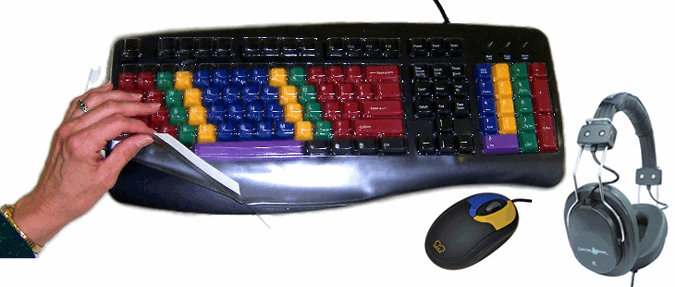
Headphones and the LittleMouse are new.  Chester Headphones are sturdy and adjustable enough for everyone, plus comfy and with convenient inline volume control.  The LittleMouse is perfect for kids still learning (color-coded!), or anyone who doesn't want to worry about a scroll wheel.


Large-key numeric pad is up coming soon.  This keypad is intended as a companion to any of our large-key keyboards for those who prefer the grid layout of numbers, but is also useful paired with any keyboard for those who like or need larger keys.  The keypad should be available by the end of the month.


The Wireless VisionBoard should be in by the end of the month, as well.  This keyboard is very similar to our VisionBoard, but includes f-keys, and will be available in black and white to start with.


We also have some great educational software bundles coming in soon.  We will be offering a pre-K bundle and an early elementary bundle, both of which will feature five titles.


The pre-K bundle will feature:


Baileys Book House
Millie's Math House
Trudys Time and Place House
Sammy Science House
Thinking Things Toony the Loons Lagoon

Our early elementary bundle will include:
Mighty Math Carnival Countdown
Reader Rabbit 1st Grade
Typing Instructor for Kids Platinum
Reader Rabbit 2nd grade
Zoombinis Island Odyssey

Thursday, January 27, 2011

Charter Schools

Yesterday, I wrote a little about homeschooling as an education option.  This is one route that provides huge flexibility and choice regarding structure and content.  Another non-traditional education path is the charter school.

Definitions for charter schools vary from state to state, as do laws, but generally a charter school is the following:

  • A public School.
  • Created when a group individuals petition a local school board or county board of education for a charter to open an independent school in their community.
  • Sponsored by another organization, such as a local university.
  • Typically founded by educators, parents, community groups or private organizations.
  • Operated under a written contract with a state, district or other entity. 
  • Required to meet local, state, or federal standards of education.


Furhter definitions can be found at US Charter Schools.  These schools can be part of a larger public school district, or an independent district supported by the state and sponsors.The National Charter School Study has found that the top three reasons charter schools are created is to gain autonomy, realize a vision, or serve a specific group. These goals are met in a variety of ways.  Charter schools' freedom allows them to structure the learning as they like.
Parents and teachers choose charter schools primarily for educational reasons--high academic standards, small class size, innovative approaches, or educational philosophies in line with their own. Some also have chosen charter schools for their small size and associated safety (charter schools serve an average of 250 students).  -US Charter Schools
 The charter school which I used to work for, Avalon School, for instance, accepts 180 students from grades 7-12 and emphasizes growth through project-based learning -- very different from the traditional public schools in the St. Paul area.

There are so many options for education available; what works best for your family?

Wednesday, January 26, 2011

Homeschooling

Homeschooling is an increasingly popular choice among American families.  The number of homeschoolers increases by over 8% annually, and about one million US families already homeschool, according to numerous studies by individuals, organizations, and the census bureau.  Why do people homeschool?  For a number of reasons, whether it be displeasure with the public option or a desire to build stronger family bonds.  As many reasons as there are for homeschooling, there are just as many approaches.  Some of the typical homeschooling approaches are listed here.

Two of the main concerns about homeschooling are whether the children will earn to socialize and whether or not they will match traditionally schooled peers in learning.  Studies have shown that contrary to the belief of some, homeschooled children tend to be more confident in social situations and less peer-dependant. As to the speed and quality of learning, every child learns differently.  This is true of homeschooled children as well as traditionally-schooled kids.  The quality of their learning depends entirely upon their natural abilities and the parents' commitment.  There is no reason a homeschooled child cannot have an education as good as or better than any public-school student.  The other worry is cost.  According to homeschool.com, one of the internet's largest homeschool networks, homeschooling can cost as little or as much as the parent's decide.  Resources include free work sheets and expenszive boxed curriculum.  Peripheral educational devices like computers can also be very important to learning.  Much of the free curriculum is available through the web, after all, and skills like typing and research are indispensable in today's world.

To help both traditional and non-traditional educational programs, Chester Creek offers a 10% discount for orders that can be verified as part of a library or education program.

What techniques do you use in your homeschooling adventures?

Thursday, January 6, 2011

Kids' Keyboards

Children, in some cases even toddlers, are now using computers at home and in school. However, learning the keys can be very frustrating for a child. All the keys look the same, the typeface is small, and the keys are often hard to reach. Children become discouraged and confused trying to remember the location of specific letters. Chester Creek’s keyboards for kids are great tools. Specially designed, with bold color-coding for vowels, consonants, numbers, and function keys, our children’s keyboards eliminate frustration and stress, providing a valuable, fun, and successful learning experience.


Teaching a child to use a computer at an early age can give them a head-start advantage. Knowledge of computer use and navigation can help stream line the process of creating projects and doing research for school. Later in life, good typing skills can cut work time in half for essays and papers, and in the work environment computer skills are a must.

An investment in your child’s computer skills is an investment in their future. One of the best values on the market today is a keyboard from Chester Creek. Chester Creek produces keyboards that are safe, sturdy, and practical. With boards in both standard and large-key layout, color-coded by character-set or finger placement, CCT has everything your child will need to learn to type quickly and correctly. Additionally, Chester Creek mice are designed specifically with a child’s hands in mind. Smaller and easier to grip and use, a CCT child’s computer mouse is also long-lasting, well-constructed, and color-coded. Our mice come with one or two buttons and with or without a scroll wheel, depending on what you, the consumer, need.

Tuesday, December 28, 2010

Assistive Technology Keyboards

Typing can be the ideal solution for those with learning or motor impairments that prevent them from easily expressing themselves with pen (or pencil) and paper, for school work, correspondence, or any one of a number of needs. The problem is that standard keyboards are boring, hard to read, and feature small keys.
Our large-key keyboards feature large print, high visibility, and 1” keys. This makes typing significantly easier for those with sight or dexterity limitations. The VisionBoards, for instance, comes in three color arrangements: white on black, black on white, and a special black on yellow color scheme that has proven very useful for individuals with macular degeneration. We also offer large-key keyboards for kids with bight, fun, color-coded keys to help kids locate letters and stay interested. All of our large-key keyboards eliminate unnecessary and confusing hot keys and are available with or without F-keys.


We also offer a great key-guard made to fit snugly over our large-key keyboards. This is a metal guard that prevents a user from accidentally pushing wrong or multiple buttons. The guard can also aid in use by individuals pushing the keys with a tool.

Our small mice are also a wonderful solution for special needs or dexterity impaired users. Many find the smaller size of a Chester Mouse, TinyMouse, or LittleMouse easier to grip and manipulate. The Chester is a one-button mouse, for added ease of use.

Chester Creek is working on a great new product called TextSpeak, designed to help vocally impaired individuals communicate.  Look for more on this later in the week.

Monday, December 6, 2010

Tiny Mouse

Tiny Mouse
Parents or teachers who are thinking about introducing children to a computer at an early age should consider investing in a kid’s mouse. A children’s mouse works just like a regular mouse, but it is smaller and much easier to use for little hands or individuals with dexterity problems. A kid’s mouse may also have fewer buttons. Chester Creek’s Tiny Mouse is a standard three button mouse, only in miniature. It is great for kids, because the size makes it something that they can easily grip. This also facilitates clicking and dragging because the buttons are in easier reach, reducing the frustration kids can feel, even with the myriad age-appropriate educational games offered. This can also benefit those with dexterity or learning impairment.
Additionally, our kid’s mice use optical tracking technology. This is opposed to the ball from older models that often got dirty and lost function. Our mice require no software to install, either, and the ease of plug and play means that you can switch mice with users, keeping a standard mouse for adult users and fun, kid’s mouse for children. This is perfect for use at home, in school, or at the daycare. Teachers have found Chester Creek’s line up of kid’s mice to be more durable than standard mice, and kids will love learning with a moues made just for them.

Monday, November 22, 2010

Touch Typing

Touch-typing is a skill wherein the typist does not look at the keyboard, enabling him or her to read while typing.  This significantly increases speed of typing as well as accuracy.

Wikipedia has to say of touch-typing:
Touch typing can efficiently bring an average speed typist to 60 words per minute (WPM) fairly quickly and at the same time increase accuracy by great amounts. Upon learning to touch type, comfortable typing speed is expected to be achieved within a month. The typing speed can be increased gradually with regular practice and speeds around 60wpm could be achieved within a year or so. Many websites and software are available to learn touch typing and many of these are free. Learning touch typing can be stressful both to the fingers as well as the mind in the beginning, but once it is learned to a decent level, it exerts minimal stress on the fingers.
Furthermore,
Studies have also shown that two-finger typists, also known as "Hunt-and-Peck" typists can reach speeds of about 37 wpm when typing memorized text, and 27wpm when copying text.

On the other hand, the average person using the touch type method can reach an average speed of 50 to 70 wpm with some reaching speeds in excess of 80 to 95 wpm. Some touch-typing experts can even reach speeds pf over 120 wpm. (The Benefits of Learning to Touch Type)
One of the biggest obstacles to learning to touch-type is overcoming the urge to peek at the keys.  Many typing teachers have students drape pieces of cloth over the keyboard.  As someone who experienced this in school, I can tell you what many others would: this is a pain in the behind.  Chester Creek has a solution, however.

Our SpeedSkins fit snugly over all standard keyboards, including MacPro keyboards, and covers only letter, number, and punctuation keys.  Additionally, the product is latex-free, durable, and easily washable, making it great for classroom use. 

Ask about our educators' discount!

Wednesday, November 17, 2010

LessonBoard Teaches Kids to Type

Our LessonBoard is a beautiful, standard sized keyboard for those learning to touch type.  In a computer saturated world, quick typing is key to success in school and in the work place.  The LessonBoard is unique in that the keys are color-coded by finger placement.  Here is what a former computer teacher had to say about our LessonBoard.  Click to read more.

The LessonBoard exceeded all of my expectations. I would even go so far as to say that if you want to teach a child how to type, either at home or at school, this is the easiest way to avoid stress, tears and arguments.

Click here to follow MommySite on Twitter
or Click here to follow Chester Creek on Twitter

Tuesday, November 16, 2010

Chester the Mouse

Chester the Mouse is a great kid's mouse.  Single click to avoid mistakes or confusion, built of sturdy materials to stand up to even the roughest use, this is a perfect mouse for children.  Great in home or classroom, we do offer an educators discount.

Thursday, November 11, 2010

G'Day!

Watch out Australia; Here we come! Chester Creek's full line of products is now available to our pals in the land down under! Check out Spectronics to order products in Australia and New Zealand.

Can you tell how excited we are about this?

Categories

3d About us accessories add adhd adults adventures aid android antikythera app artsy asd assistice technology assistive technology augment autism back to school belgium big birthday blog boomer boxes braille bundle buzz canada catalog cd ces chater chest creek chester creek chester creek blog chester creek news chester mouse children childrens choice Christmas chrome church cnn coffee cold colored colorful comics coming soon commerce communication computer computer accessories computer accessorites computers computex consumer copptertop cpsia customer danbit denmark dexterity disability dissident distributors doppleganger duluth ebullient ed expo education elderly email employment eniac enviromental ergnomics ergonomics eye facebook facial recognition facts fall famous february fiber optics fiction flu funkeyboard funkeybundle furtive games genes German germs glaucoma google hacking handicap harbor Headset health heavy metals High visibility history holiday holidays holoday home school homeschool hypertext impaired impairment info information intel international internet ipad italian italy key guard keybaords keyboard keyboard seals keyboarding keyboards kids kidscomputer kinderboard kinect laptop large key large-key large-print lead learn to type learning lessonboard light links little low vision lumbar m-w macular degeneration magic malware mercury merriam-webster mice microsoft minnesota mobile motor mouse national school supply and equipment association netbook network new blog new products new technology new years news nssea number pad numeric occupation therapy occupational therapy office on-the-go outdoors peripheral phones photo portable posture productivity products announcements promotion proteins ramblings readerboard restriction review rohs safety sale sales scary school schools science scores search engines security senior seniors services shellacking shipping shopping sight silly social media social networking software spanish special education special needs special olympics specialneeds specials spectronics speech speedskin spring squirrels staff story students study summer suppliers tablet tablets taipei technology tests text speak textspeak the cloud tinymouse tips touch-typing trade show typing vacation viruses vision visionboard vocabulary wave weather web what's new wifi windows winter wireless words work wrapping www